Every year when the rains return to South Florida, our phones light up with the same call: 'There's dirty water — or worse — coming up through the drain in my downstairs bathroom, and I haven't run anything.' The homeowner assumes they have a clog. Most of the time they don't. What they have is the public sewer main filling up faster than it can drain during a heavy storm, and the only place that backed-up water can go is up the lowest pipes connected to the system — which happen to be inside their house. With the National Weather Service's South Florida rainy season running roughly May 15 through October 15, and the 2026 Atlantic hurricane season open as of June 1, this is the single most common storm-related plumbing emergency we see across Miami-Dade, Broward, and Palm Beach.
Why South Florida is uniquely prone to sewer backups
Three things about this region stack the deck. First, the land is flat and low — much of Miami-Dade and Broward sits only a few feet above sea level, so the fixtures on your ground floor or slab are often at nearly the same elevation as the sewer main in the street. Second, the water table is high, so heavy rain saturates the ground quickly and groundwater seeps into aging sewer pipes through cracks and joints (engineers call this inflow and infiltration), filling the main with stormwater that was never supposed to be there. Third, during a real downpour or a tropical system, the gravity sewer system simply receives more water than it can move, and the level inside the main rises above the level of your lowest fixtures. Water always finds the lowest opening, and that opening is your floor drain.
What a backwater valve actually does
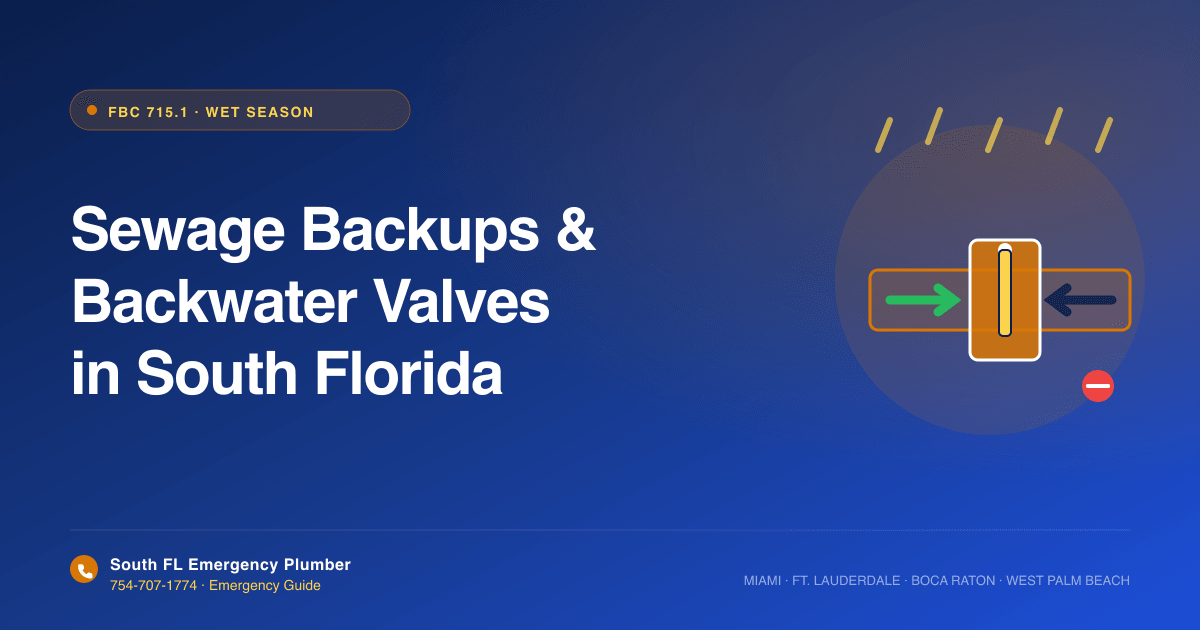
A backwater valve (also called a backflow valve or, loosely, a 'sewer check valve') is a simple, mechanical one-way gate installed in your building drain — the main pipe that carries everything out of the house to the city sewer. When wastewater is flowing the right direction, out toward the street, a hinged flap or float sits open and lets it pass. The moment water tries to reverse and flow back toward the house, that flap is pushed shut, sealing the line and keeping the sewer's contents out of your home. When the storm passes and the main drains down, the valve reopens on its own. It's one of the few plumbing devices that protects you from a problem that originates entirely outside your property line.
The catch is placement. A backwater valve protects only the fixtures downstream of it, and any fixture upstream of the valve that sits below the backup level can still be a problem — which is exactly why the location and type of valve matter, and why this isn't a job for guesswork. Done right, the valve goes on the building drain serving the low fixtures, with the upper floors arranged so they don't discharge through it.
What the Florida Building Code requires
This isn't just a nice upgrade — for many South Florida homes it's code. Florida Building Code, Plumbing, Section 715.1 (Sewage Backflow) states that where plumbing fixtures are installed on a floor with a finished floor elevation below the elevation of the manhole cover of the next upstream manhole in the public sewer, those fixtures must be protected by a backwater valve installed in the building drain or the horizontal branch serving them. The same section says fixtures above that manhole elevation must NOT discharge through a backwater valve — because you don't want an upstairs bathroom relying on a valve that, if it sticks, could back the whole upper house up. The code also requires the valve to meet a recognized standard (ASME A112.14.1 or the CSA B181 series) and to be installed with access so it can be inspected and cleaned. On South Florida's flat, near-sea-level lots, a surprising number of ground-floor fixtures fall under that 'below the upstream manhole' rule.
Why this matters for condos, HOAs, and commercial buildings
Ground-floor and below-grade fixtures are exactly where multi-family and commercial buildings get hurt. A lobby restroom, a ground-floor unit, a parking-garage trench drain, a commercial kitchen, or a below-grade mechanical room can all sit below the upstream manhole elevation, and when the main surcharges during a storm, that's where sewage surfaces first — often into finished, occupied space. For property managers and HOA boards, a single storm backup into a ground-floor unit can mean biohazard remediation, displaced residents, and a fight over which policy pays. We work with property-management portfolios and HOA boards across the tri-county area to map where the low fixtures are, confirm whether existing backwater valves are present and functional, and put a maintenance schedule on them so they actually close when they're needed.
Backwater valves need maintenance to work
A backwater valve is mechanical, and a flap that's gummed up with grease, wipes, or scale won't seal when the storm hits. Because the code requires the valve to be installed with access, a working valve can be opened, inspected, and cleaned without cutting pipe. We recommend checking it before the heart of rainy season every year — which, in South Florida, means now. If you have a valve and don't know the last time anyone looked at it, assume it needs servicing.
Should you have one installed?
- You've had sewage or gray water come up through a low drain, shower, or toilet during heavy rain — even once. That's the clearest signal.
- You have a ground-floor or slab-level home in a low-lying neighborhood (much of coastal and eastern Miami-Dade and Broward qualifies).
- You're renovating a ground-floor bathroom, adding a low fixture, or finishing a below-grade space — the right time to add a valve is while the line is open.
- You manage a building with ground-floor units, a garage trench drain, a commercial kitchen, or any below-grade fixture.
- Your home is on a street where you've seen the city sewer overflow at the manhole during storms.
The bottom line
Sewage backing up through a floor drain in a South Florida summer is rarely your fault and rarely a clog — it's the public sewer reaching its limit and pushing back into the lowest opening it can find, which is inside your home. A properly placed, code-compliant backwater valve is the one device that stands between that overloaded main and your floors. With the rainy season already running and hurricane season open, the time to find out whether you're protected is before the next big rain, not during it.
Need a Plumber Now?
24/7 service across Miami-Dade, Broward & Palm Beach. Same-day availability.